Peptide degradation is the set of chemical and physical changes that alter a peptide from its intended structure. The chemical routes include hydrolysis of amide bonds, oxidation of side chains, deamidation, and disulfide exchange, and the physical route is aggregation. Each produces a species with a different mass, charge, or conformation from the parent molecule, and each is characterized analytically in the research literature.
Degradation matters in research because a measurement made on a degraded material describes a mixture. A receptor assay run on a sample containing oxidized or truncated species reports the behavior of that mixture, not of the intended sequence. This overview describes what the chemistry literature reports about these pathways and how they are detected. It is a methods-oriented summary of chemistry and gives no guidance on use of any compound.
What are the main chemical degradation pathways?
Five pathways account for most of what is described in the peptide chemistry literature: hydrolysis, oxidation, deamidation, disulfide exchange, and aggregation. They differ in which residues they involve and in how they change the molecule.
Hydrolysis cleaves the amide bond between residues, producing shorter fragments. Oxidation modifies susceptible side chains. Deamidation converts asparagine and glutamine side chains toward acidic residues. Disulfide exchange rearranges sulfur-sulfur bonds in cysteine-containing peptides. Aggregation is a physical process in which peptide molecules associate into dimers, oligomers, or larger assemblies. A single sequence can be affected by several of these at once, and the relative importance of each depends on the sequence and on the medium in which the peptide is studied.
How does sequence determine which pathway dominates?
Sequence is the main determinant, because each pathway targets particular residues. A peptide with no methionine or cysteine has no site for the most common oxidation reactions. A peptide with an asparagine followed by a small residue such as glycine has a recognized hot spot for deamidation, which proceeds through a cyclic succinimide intermediate.
The published literature on sequence-dependent stability treats these motifs as the first thing to examine when a new peptide is characterized. Aspartic acid residues are associated with a separate hydrolytic route in which the bond adjacent to the residue is cleaved more readily than other amide bonds. Residues with hydrophobic stretches contribute to aggregation tendency. Reading a sequence for these motifs gives a map of where change is most likely, before any experiment is run.
How does oxidation affect peptides containing sulfur residues?
Oxidation is the pathway most directly tied to sulfur-containing residues. Methionine oxidizes to methionine sulfoxide, a change that adds about 16 Da to the mass and that is readily seen by mass spectrometry. Cysteine thiols can pair into disulfide bonds or move to higher oxidation states. Tryptophan, histidine, and tyrosine have also been reported as oxidation-prone in some systems.
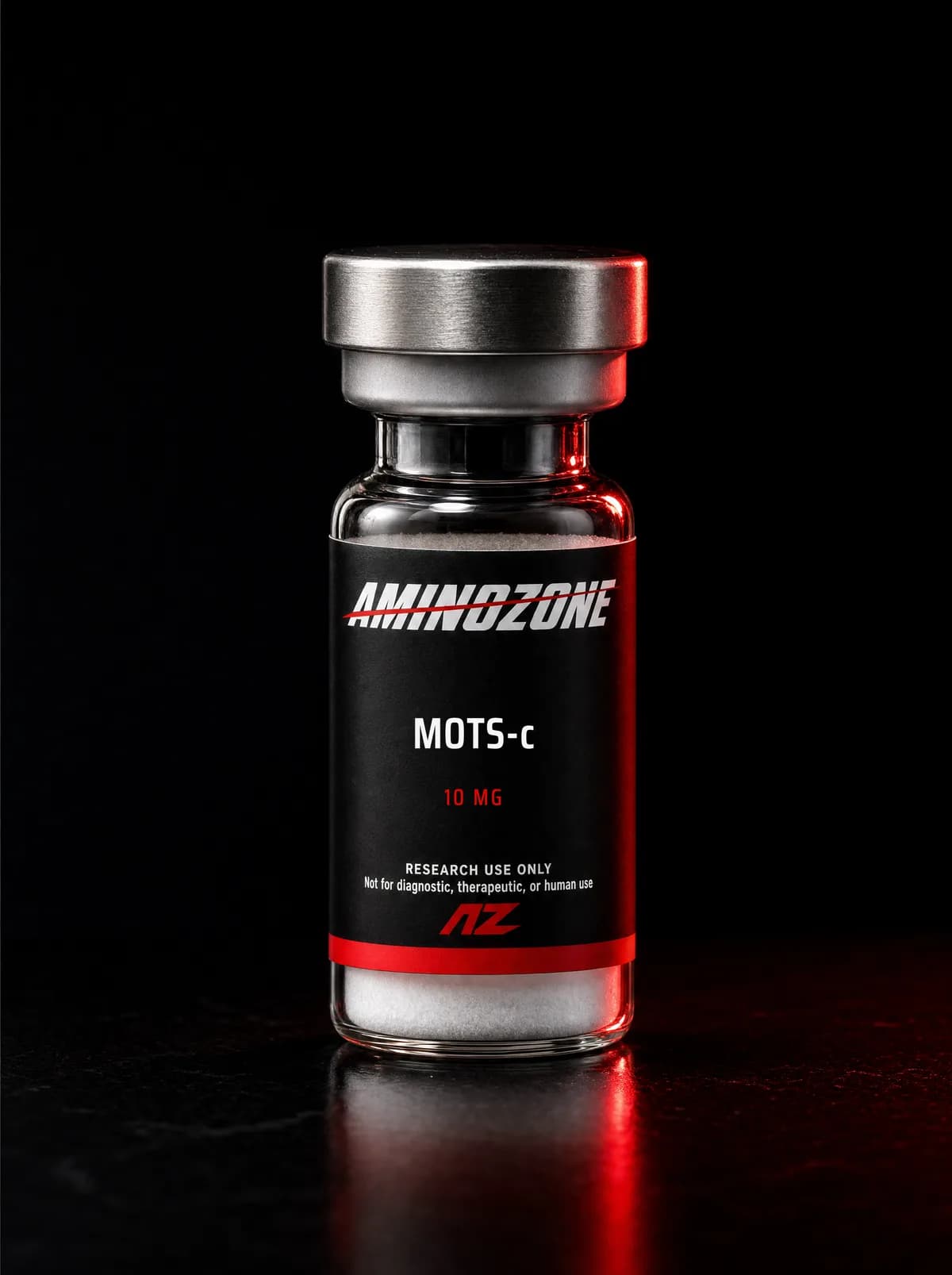
The catalog gives concrete examples of sulfur content. MOTS-c has the molecular formula C100H152N28O22S2 and a molecular weight of 2174.59 g/mol, and the two sulfur atoms in the formula mark the sulfur-containing residues of the sequence. Cagrilintide has the formula C194H312N54O59S2 and a molecular weight of 4409.01 g/mol. Sulfur count in a formula is a quick first indicator of how many positions are candidates for oxidative change, which is why it is often noted when a peptide is characterized.
What can a small molecule like glutathione show about thiol chemistry?
Glutathione is a useful reference because its thiol chemistry is well characterized. Glutathione is a tripeptide with the formula C10H17N3O6S, a molecular weight of 307.32 g/mol, and CAS 70-18-8 in the Amino Zone catalog. Its single cysteine thiol is the center of its redox behavior, and the oxidized form is a disulfide-linked dimer.
The glutathione redox couple is a standard system in the literature for illustrating how a thiol and its disulfide interconvert. The same thiol-disulfide chemistry applies to cysteine-containing peptides in general, and it is the reason disulfide exchange appears in lists of degradation pathways. A deeper treatment of the compound itself is in the Glutathione research overview.
How is peptide degradation detected analytically?
Detection relies on separating the parent peptide from its degradation products and then identifying what is left. Reversed-phase HPLC separates species by hydrophobicity and reports purity as the share of total peak area, and mass spectrometry identifies each peak by its mass. The pairing of the two is the standard approach.
Characteristic mass shifts make identification systematic:
Oxidation of methionine appears as a shift of about +16 Da relative to the parent mass.
Deamidation appears as a shift of about +1 Da, which requires a high-resolution instrument to resolve cleanly.
Hydrolysis appears as lower-mass fragments whose masses sum to the parent.
Disulfide exchange appears as species with the same mass but different retention times.
Aggregation appears in size-exclusion chromatography as species eluting earlier than the monomer.
Tandem mass spectrometry extends this by fragmenting an ion and locating the modification at a specific residue, which is how the literature assigns oxidation or deamidation to a particular position.
What does a purity value say about degradation?
A purity value is a narrow measurement. It reports the share of UV-absorbing peak area attributed to the main species at the time of analysis, using one chromatographic method. It does not describe how a material changes over time, and it can miss species that co-elute with the main peak or that absorb poorly.
For that reason, characterizing degradation means repeating analysis across time points under defined conditions and comparing the profiles. A single certificate of analysis is a snapshot. The documentation conventions around such certificates, and what they can establish, are discussed in research peptide purity standards in 2026.
Identity confirmation adds a second layer. A mass spectrum that matches the theoretical mass shows the right molecule is present, and the absence of satellite peaks at +16 Da or +1 Da is informative about the oxidation and deamidation pathways described above.
What are the limits of current degradation research?
Most of the published stability literature comes from pharmaceutical peptides and proteins, which have been studied far more extensively than research-grade sequences. Findings carry over by chemistry, since the residue-level reactions are general, but rates and dominant pathways are specific to each sequence and medium, and a conclusion drawn for one peptide does not transfer to another by default.
Analytical limits also apply. Low-abundance species can sit below detection thresholds, deamidation is hard to resolve from the parent mass, and aggregates can be lost in sample preparation. These are reasons the literature favors orthogonal methods, where HPLC, mass spectrometry, and size-based separations are read together rather than any one alone.
A further point concerns reporting. Methods sections in the literature increasingly name the column, gradient, detection wavelength, and mass analyzer used, because a purity figure cannot be compared across laboratories without them. Naming the instrument and acquisition mode also lets a reader judge whether a +1 Da deamidation shift could have been resolved at all.
Research use disclaimer
The compounds referenced in this article are supplied by Amino Zone strictly for in vitro laboratory research and analytical use. They are not drugs, dietary supplements, or foods, and are not intended for human or veterinary use. This article summarizes published chemistry on peptide degradation and makes no claim about the safety or effects of any compound in a living organism. For research purposes only.
Reference
Common questions
The main pathways in the peptide chemistry literature are hydrolysis of amide bonds, oxidation of susceptible side chains, deamidation of asparagine and glutamine, disulfide exchange, and aggregation. Which pathway dominates depends on the amino acid sequence, the medium, and the conditions of the experiment.
Methionine and cysteine are the residues most often named as oxidation-prone. Methionine oxidizes to its sulfoxide, adding about 16 Da to the mass, and cysteine can form disulfide bonds or higher oxidation states. Tryptophan, histidine, and tyrosine are also reported as susceptible in some systems.
Reversed-phase HPLC separates a peptide from its degradation products by retention time, and mass spectrometry identifies them by mass shift. Oxidation adds roughly 16 Da, deamidation adds roughly 1 Da, and hydrolysis produces fragments. Size-exclusion chromatography is commonly used to detect aggregates.
No. A purity value is a measurement by one method at one time point, expressed as peak area. It does not describe how a material changes over time, and degradation products that co-elute with the main peak or lack UV absorbance can be missed. Stability is characterized by repeating analysis across time points.