Amino Axiom is a free research information and tracking platform for the peptide research community. Its central section is a library of 79 research compounds, each with an entry covering sourced mechanism notes, structural information, and regulatory-status notes. The library is available at Amino Axiom's compound library.
For a metabolic research program the library works as a first stop. A researcher meeting a new compound name wants three things quickly: what the molecule is, what pathway it is reported to act on, and how it is classified. The entries are organized to answer those questions in that order. This post describes how to read an entry and how to compare entries across the metabolic compounds a program is likely to encounter. It is a reading guide, and nothing here describes use of any compound outside a laboratory setting.
How is a library entry organized?
Each entry follows a consistent layout, which is what makes the library usable as a reference rather than a collection of articles. The top of an entry gives the compound's name, common synonyms, and category. Below that sit the mechanism section, the structural section, and the regulatory-status note, with sources attached where the entry makes a factual claim.
The mechanism section summarizes what published work reports about the compound's molecular target and signaling pathway. It is written at the level of receptor and pathway, for example which receptor class is engaged and which second messenger system follows. The structural section covers what kind of molecule it is: a linear peptide, a lipidated analog, a small molecule, and so on, along with identifiers where available. The regulatory-status note records how the compound is currently classified, which matters for institutions that need to document the status of materials they handle.
A good habit is to read the entry top to bottom once, then return to the sources for any statement that will be relied on in a paper or a protocol. The entry is a summary of the literature and a guide to it, and the sources are what the researcher should actually cite.
How can the library be used to compare compounds in the same class?
Comparison is where a structured library earns its place. Consider the incretin and amylin area, where a study panel might include more than one receptor family.
Mazdutide is a synthetic dual agonist of the GLP-1 and glucagon receptors. Its entry places it in the incretin-related category and describes engagement of two class B GPCRs. Cagrilintide, by contrast, is an amylin analog acting through a receptor complex that is distinct from the GLP-1 receptor. Reading the two entries together shows that they are not interchangeable even though both appear in discussions of metabolic signaling. One engages two receptors in the incretin and glucagon family. The other engages the amylin receptor complex, which is built from a calcitonin receptor and accessory proteins.
That difference has direct consequences for experimental design. Cell lines, receptor expression, and readouts chosen for one mechanism may not be appropriate for the other. A researcher who reads the entries in sequence is reminded of this before designing a panel, instead of discovering it after the first set of results.
What does the library offer for non-incretin metabolic compounds?
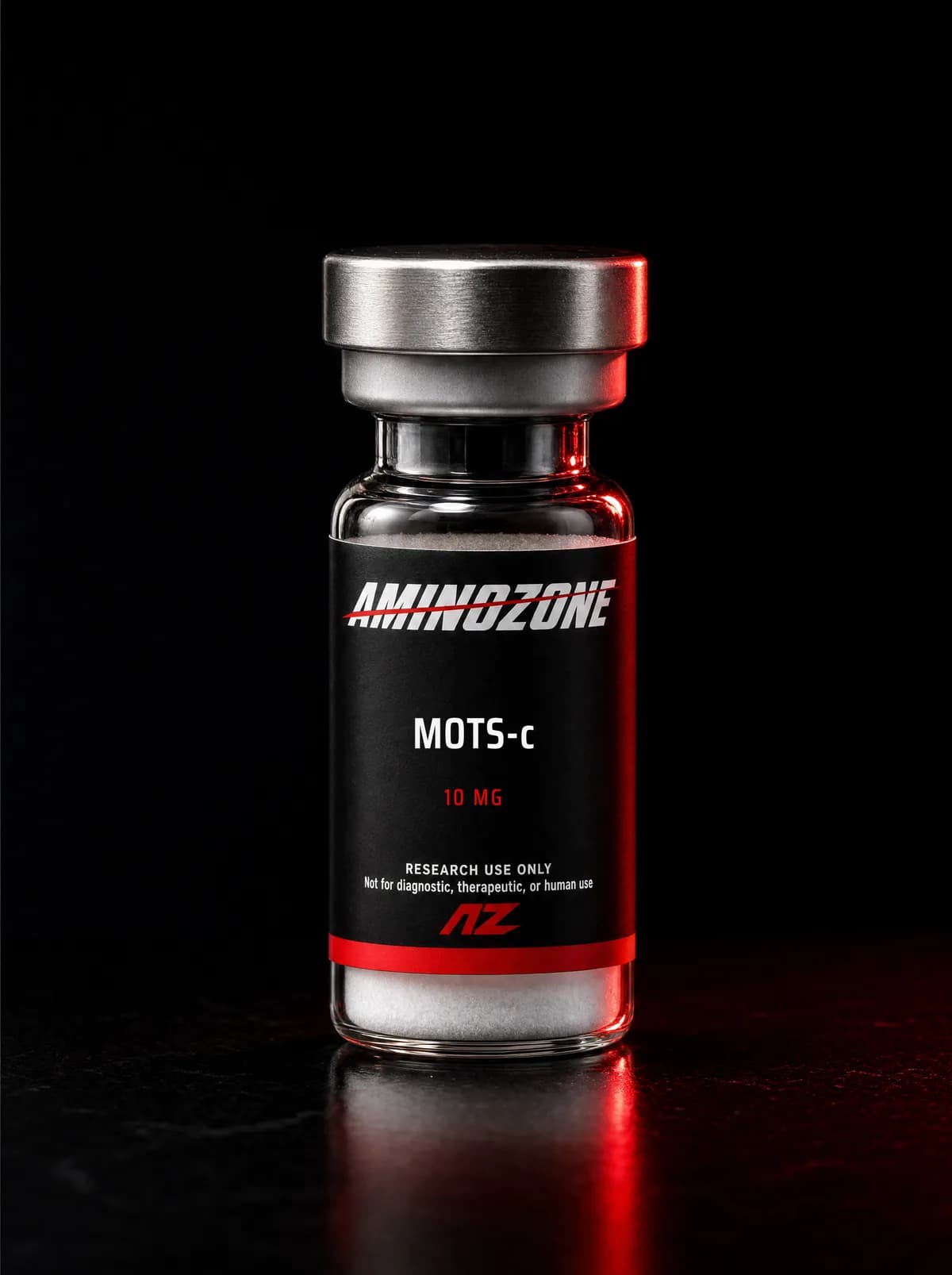
Metabolic research also covers energy-sensing pathways that have little to do with incretin receptors. MOTS-c is a mitochondrial-derived peptide studied in AMPK and metabolic homeostasis models. Its library entry places it in a different category from the incretin compounds and points to a different set of assays.
Reading this entry after the Mazdutide and Cagrilintide entries is instructive. The category label changes, the pathway description changes, and the kinds of sources cited change. A researcher can see at a glance that the literature on this peptide is organized around mitochondrial signaling and cellular energy sensing, with its own models and controls, rather than around receptor-binding pharmacology. Moving between categories in the library is a quick way to build a working map of the field, and it helps a program decide which parts of the literature it needs to read in depth.
How do you read a library entry, step by step?
Reading an entry is easiest as a fixed sequence:
Read the name, synonyms, and category at the top to confirm the entry matches the compound named in the paper.
Read the mechanism section for the receptor class or pathway, and note the sources it cites.
Read the structural section for molecule type and identifiers, and copy those into the notebook from the record.
Read the regulatory-status note and flag anything to confirm with the institution.
Return to the cited sources for any statement that will be relied on in a paper or protocol.
Applied to the worked examples above, the structural step produces a small reference table from the Amino Zone catalog:
How should structural information in an entry be used?
Structural fields are the most frequently copied part of any reference entry, and the part where errors are most costly. A molecular formula, molecular weight, or CAS number typed from memory into a methods section can propagate through several documents before anyone notices a problem.
The reliable approach is to copy identifiers from a catalog record and cross-check them against the certificate of analysis for the lot in hand. The Amino Zone catalog lists Cagrilintide with CAS 1415456-99-3, formula C194H312N54O59S2, and a molecular weight of 4409.01 g/mol, and lists MOTS-c with CAS 1627580-64-6, formula C100H152N28O22S2, and a molecular weight of 2174.59 g/mol. A researcher comparing these against the library entry for the same compounds is performing a useful consistency check. If a figure differs between sources, the discrepancy is worth resolving before it reaches a manuscript.
Molecular weight differences also carry information. The gap between a peptide of roughly 2,200 g/mol and one of roughly 4,400 g/mol reflects a real difference in size and structure, and it affects analytical choices such as mass spectrometry settings and chromatography conditions. The library's structural section is a convenient place to see those differences laid out across compounds.
How should the regulatory-status note be read?
The regulatory-status note records how a compound is currently classified. For a research institution, that classification can affect procurement paperwork, storage and handling documentation, and review by an institutional committee.
The note is a snapshot. Classifications change as regulators act and as compounds move through development, so the note should be treated as a starting point for a check with the institution's compliance office, not as a final answer. A researcher preparing documentation for a study can use the note to know what to ask about, then confirm the current position directly with the relevant authority.
It is also worth noting what the note does not do. It does not describe use of a compound, and it makes no statement about suitability for any purpose beyond laboratory research. Keeping that boundary clear matters when summarizing library content in lab documents.
How can the library support a literature-review workflow?
A library of 79 entries is small enough to browse and large enough to cover most of the compounds a metabolic program is likely to meet. A practical workflow uses it as an index.
Start with a list of the compounds in the study. Open each entry and record the category, the target pathway, and the key sources. Where two compounds share a category, read their entries together and note the differences. Where a compound sits in a category by itself, treat that as a signal that it needs separate reading. The result is a one-page map of the study's compound set, with the primary sources already identified.
The library's glossary and keyword search support this. A term that appears in an entry, such as AMPK or class B GPCR, can be looked up without leaving the platform, and a compound searched by an older synonym lands on the same entry as its current name. Consistent naming across sections reduces confusion when the primary literature uses several names for one molecule.
Where does the library fit among other Amino Axiom sections?
The library is the reference core of the platform. Other sections build on it: the vendor directory tracks suppliers, the price tables list vendor pricing for each compound, and the community section hosts discussion. Entries in the library are the shared point of reference for all of them, which is why a compound's name and category stay the same wherever it appears.
For a program that wants to start from the science and then move to practical questions, the library is the right entry point. To open it directly, use the Amino Axiom homepage or the compound library link above.
Research use disclaimer
The compounds referenced in this article are supplied by Amino Zone strictly for in vitro laboratory research and analytical use. They are not drugs, dietary supplements, or foods, and are not intended for human or veterinary use. This article describes how to read a reference library and makes no claim about the safety or effects of any compound in a living organism. For research purposes only.
Reference
Common questions
The library holds 79 research compounds as of October 2026. Each has an entry covering sourced mechanism notes, structural information, and a regulatory-status note, organized so a researcher can learn what a molecule is, what pathway it is reported to act on, and how it is classified.
Each entry gives the compound's name, synonyms, and category, followed by mechanism, structural, and regulatory-status sections with sources attached to factual claims. The mechanism section works at receptor and pathway level, and the structural section states molecule type and identifiers where available.
Copy identifiers from a catalog record and cross-check them against the certificate of analysis for the lot in hand. For instance, MOTS-c is listed with CAS 1627580-64-6 and a molecular weight of 2174.59 g/mol. If a figure differs between sources, resolve the discrepancy before it reaches a manuscript.
No. The note is a snapshot of how a compound is currently classified, and classifications change as regulators act. Researchers use it to know what to ask, then confirm the current position with their institution's compliance office or the relevant authority before documenting procurement or handling.