Amino Axiom is a free research information and tracking platform for the peptide research community. Its web version includes a compound reference, price tables, a vendor directory, a glossary, and a community forum. The iOS app is the native version of the same platform, distributed through the App Store. It carries the same compound library, the same price data, and the same community, in a layout built for a phone.
The platform's home is Amino Axiom, and the app is linked from there. This post describes what the app shows and how a researcher working in metabolic signaling might fit it into a normal working day. It is a reading guide, not a product page, and nothing here describes use of any compound outside a laboratory setting.
Why would a metabolic researcher want a phone version of a reference platform?
Most reference work happens at a desk, but a fair amount of it does not. A researcher in a lab meeting is asked which receptor a compound engages. A colleague at a poster session mentions an unfamiliar name. Someone is reading a methods section on a train and wants the molecular formula of a compound without opening a laptop. In each case the useful tool is the one already in a pocket.
The app does not add new science. It shortens the path between a question and a catalog record. In metabolic research, where several compound families with similar-sounding names are often discussed in the same conversation, that short path reduces the chance of mixing up two molecules. A phone lookup that takes seconds is more likely to happen than a laptop lookup that takes minutes, and a check that happens is better than a check that gets skipped.
What does the app show?
The app mirrors the structure of the web platform. The main areas are the compound library, price tables, the vendor directory, search, the glossary, and community discussion. Each compound entry gathers the same fields a researcher would see on the web: names and synonyms, category, mechanism summary, structural information, and regulatory-status notes. Entries are written for reference reading, so they can be scanned quickly on a small screen.
Search is keyword-based. A researcher types a compound name, an abbreviation, or a term from the glossary and gets matching entries. That sounds modest, but synonyms matter a great deal in this field. The same peptide may appear under a code name in older papers and a different name in newer ones, and a keyword search that catches both saves a detour through the literature.
Because the app reflects the same data as the web platform, a record opened on a phone matches the one opened on a desktop later. That consistency is useful for notebook work: a researcher can note a detail from a phone lookup and confirm it against the full web entry when sitting down to write.
How can the app be used for incretin-axis compounds?
The incretin axis is a good illustration, because it contains several molecules that are easy to confuse. Mazdutide is a synthetic dual agonist of the GLP-1 and glucagon receptors. A researcher reading a paper on dual agonism may want to confirm what class the compound belongs to, what its target receptors are, and how its structure compares with single-receptor analogs. The app's library entry answers those questions at the level needed for orientation.
A second example from the same area is Cagrilintide, an amylin analog that acts through a receptor complex distinct from the GLP-1 receptor. When a study panel includes both compounds, the researcher needs to keep their pathways separate. Opening both entries in the app and comparing the mechanism summaries side by side, even briefly, is a quick way to recall why the two belong in the same experiment and where their signaling diverges.
None of this replaces reading primary literature. The app is an orientation layer. It tells a researcher which papers and which terms to look for, and the deeper reading still happens in the published structural and pharmacology work.
How does the app help with energy-sensing and mitochondrial peptides?
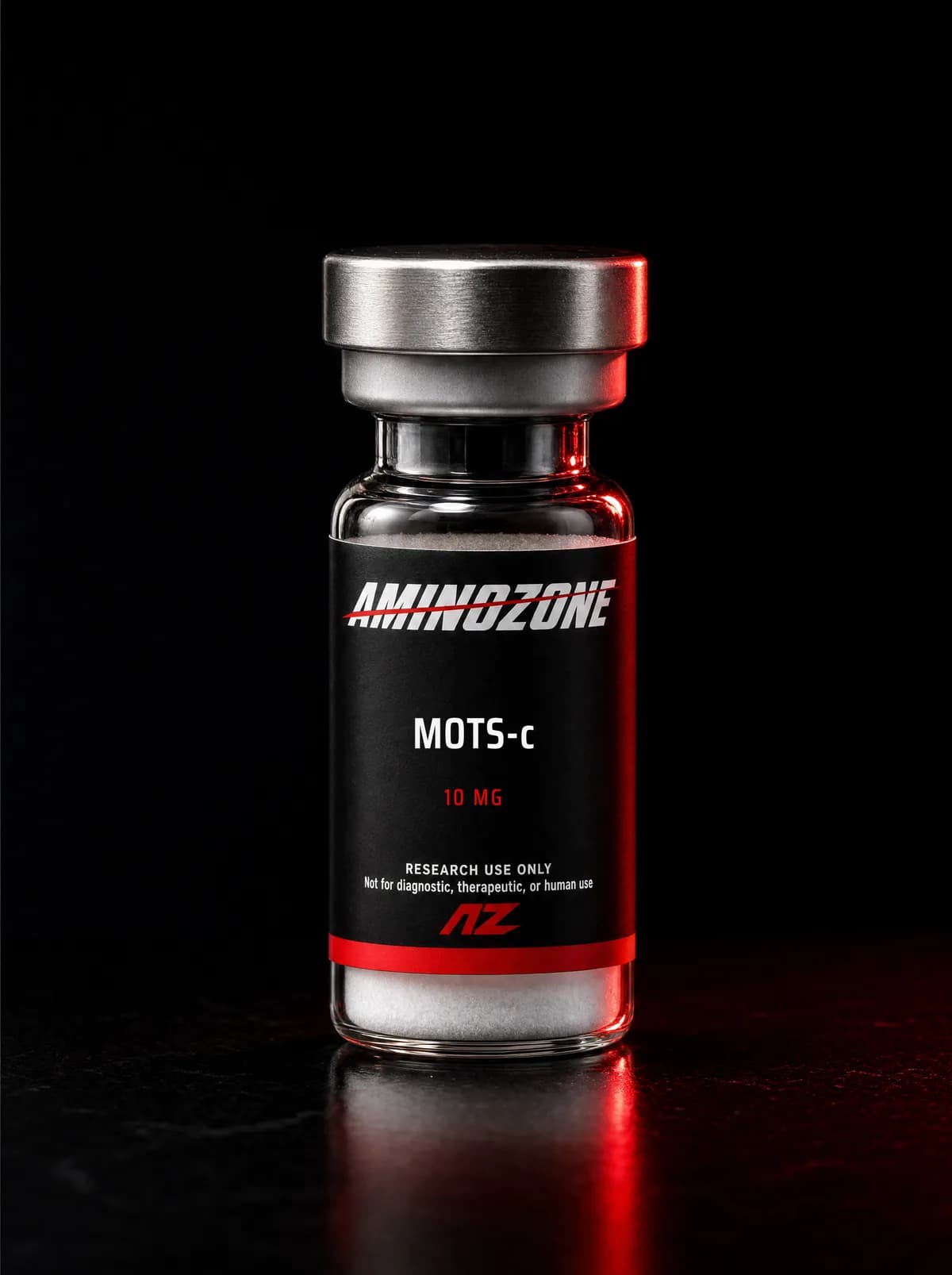
Metabolic research is not limited to incretin biology. MOTS-c is a mitochondrial-derived peptide studied in AMPK and metabolic homeostasis models, and it sits in a different branch of the literature with its own assays and controls. A researcher moving between incretin and mitochondrial papers in one afternoon is switching vocabulary constantly.
The glossary section of the app is useful here. Terms such as AMPK, cAMP signaling, class B GPCR, or receptor agonism can be looked up in place when they appear in a paper or in a colleague's slide. The glossary entries are short definitions meant to restore context, not to teach a field from scratch. For a reader who knows the incretin side well and is newer to energy-sensing pathways, a two-line definition on a phone can be enough to keep reading without losing the thread.
How do you read a compound entry in the app, step by step?
On a phone, a lookup works best as a repeatable sequence that ends with a check against primary sources.
A short routine keeps the app in its place as a reference layer:
Search the compound name, abbreviation, or any synonym from the paper being read.
Open the entry and read the category, mechanism summary, and structural fields.
Open a second entry in the same area and compare the mechanism summaries side by side.
Look up any unfamiliar term, such as AMPK or class B GPCR, in the glossary.
Record the detail in the notebook and confirm it against the full web entry and the primary source later.
The catalog figures below show why the second step is worth the few seconds it takes:
Mazdutide and Cagrilintide sit within about 190 g/mol of each other, yet they act through different receptors, which is the kind of near-neighbor confusion a quick lookup prevents. For a longer treatment of one of them, see the Mazdutide research overview.
What should a researcher verify outside the app?
A phone reference is a convenience, and it has limits that are worth stating plainly. Three habits keep it in its place.
First, identifiers used in a methods section or an order sheet should be copied from a catalog record and checked against the certificate of analysis for the specific lot. The Amino Zone catalog lists Mazdutide with CAS 2259884-03-0, formula C207H317N45O65, and an approximate molecular weight of 4599 g/mol. A researcher who sees these values in a reference platform should still confirm them against the supplier documentation that ships with the material, since lots and salt forms can differ.
Second, mechanism summaries are summaries. They compress a literature into a paragraph, and a careful reader treats them as a pointer to the underlying studies. Potency figures from an engineered cell line expressing one receptor do not transfer directly to a mixed-cell system, and a short entry cannot capture that kind of caveat in full.
Third, regulatory-status notes describe the state of a compound at a point in time. Status can change, so a researcher preparing a protocol document should check the current position with the relevant institution or regulator rather than rely on a note read in passing.
How does the community section fit into a research workflow?
The app also carries the platform's community section, a set of discussion areas where members of the research community post questions and share reading. For a metabolic researcher, the useful pattern is to treat it as a pointer to literature rather than a source of conclusions. A thread that mentions an interesting receptor pharmacology paper is worth following up in the original publication. A thread that asserts a result without a source is a prompt to look for one.
Community posts are not peer reviewed, and the app does not make them so. Reading them with that in mind, and keeping anything that goes into a lab notebook tied to a primary source, is the sensible way to use any discussion forum in a technical field.
Where does the app fit among the other Amino Axiom sections?
The app and the website are two views of one platform. The compound library gives structured records, the glossary defines terminology, the price section lists vendor pricing, and the vendor directory tracks supplier status. A researcher might use the web version for long sessions, with several records open at once, and the app for quick checks between other tasks.
The practical value is continuity. Names, categories, and entries are the same on both, so there is nothing to reconcile. For a metabolic research program that touches several compound families, that consistency removes one small source of error from the literature phase, where most avoidable mistakes happen.
Research use disclaimer
The compounds referenced in this article are supplied by Amino Zone strictly for in vitro laboratory research and analytical use. They are not drugs, dietary supplements, or foods, and are not intended for human or veterinary use. This article describes how to use a reference application and makes no claim about the safety or effects of any compound in a living organism. For research purposes only.
Reference
Common questions
Yes. The native iOS app, distributed through the App Store, carries the same compound library, price data, and community as the web platform in a layout built for a phone. Because names and entries match, a record opened on a phone corresponds to the one opened on a desktop later.
Search is keyword-based. A researcher types a compound name, abbreviation, or glossary term and receives matching entries. This helps with synonyms, since one peptide can appear under a code name in older papers and a different name in newer ones, and a single search can reach both.
No. The app is an orientation layer. Identifiers such as Mazdutide's CAS 2259884-03-0 should be confirmed against the certificate of analysis for the specific lot, because lots and salt forms can differ. Mechanism summaries and regulatory notes are pointers to primary sources and supplier documentation, not substitutes.
No. Community discussion is not peer reviewed, and the app does not make it so. A useful habit is to treat a thread as a pointer to literature, follow it to the original publication, and keep anything entered in a lab notebook tied to a primary source.