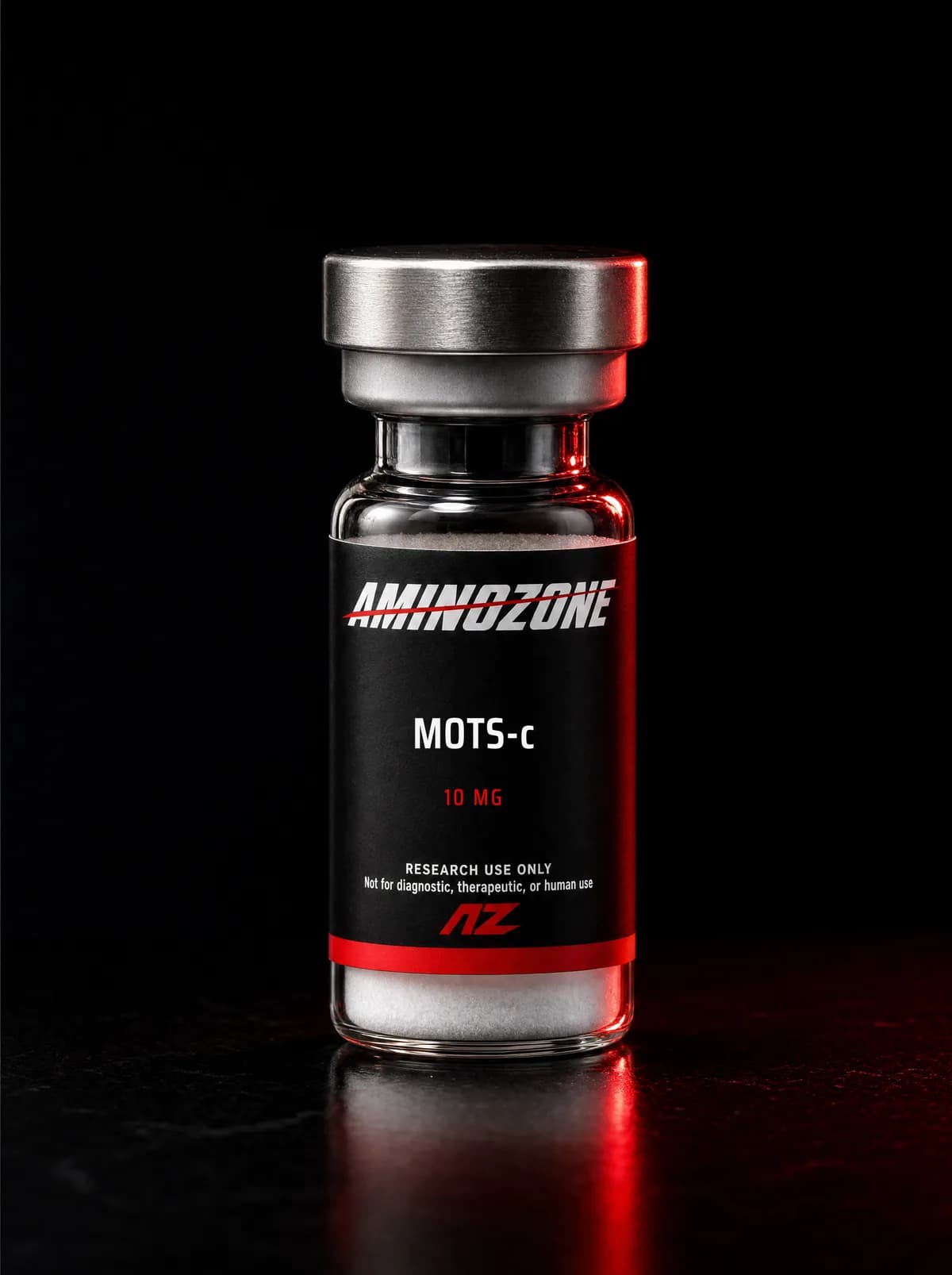
Mazdutide is a synthetic peptide engineered as a dual agonist of two class B G protein-coupled receptors: the glucagon-like peptide-1 receptor (GLP-1R) and the glucagon receptor (GCGR). It is catalogued under CAS number 2259884-03-0, with a molecular formula of C207H317N45O65 and a molecular weight of approximately 4599 g/mol. The material is produced by solid-phase peptide synthesis, supplied as a lyophilized powder, and is intended solely for laboratory research use, not for human use.
In metabolic research, Mazdutide is of interest because it combines two receptor activities in a single defined sequence. Native GLP-1 and native glucagon are both short-lived peptide hormones, and each signals through its own receptor and a shared second-messenger system. A single molecule that engages both receptors lets researchers examine how the two signaling arms interact in the same cell culture or membrane preparation, without having to co-apply two separate ligands with different stability profiles.
Amino Zone catalogues Mazdutide within its performance and metabolic research category, alongside other incretin-axis and metabolic signaling compounds used in laboratory model systems.
What is the molecular structure of Mazdutide?
Mazdutide is a long-chain synthetic peptide with a molecular weight near 4599 g/mol, placing it among the larger research peptides in the incretin class. Its scaffold is derived from the oxyntomodulin-type design logic: oxyntomodulin is a naturally occurring peptide that activates both GLP-1R and GCGR, and a considerable body of medicinal chemistry has gone into modifying that template so the resulting analog has more stable, better-defined receptor activity than the native sequence.
Several structural features distinguish engineered dual agonists from their native counterparts. Amino acid substitutions at positions that native peptidases target reduce enzymatic degradation in biochemical assays. Helix-stabilizing modifications support the alpha-helical conformation that class B GPCR ligands adopt when they engage the receptor extracellular domain and transmembrane core. A fatty acid conjugation, attached through a linker to a lysine side chain, supports reversible binding to serum albumin, which in biochemical models extends the apparent persistence of the peptide in albumin-containing media.
The catalog entry for Mazdutide lists storage as lyophilized at -20 °C and a purity specification of 99% or higher, verified by HPLC purity analysis and mass spectrometry identity confirmation. Because the molecular weight is large and the sequence contains a lipid modification, mass spectrometry is a particularly important identity check: it confirms that the conjugated species, rather than a truncated or unconjugated side product, is the predominant material.
How does a dual GLP-1R and GCGR agonist signal in cell models?
Both GLP-1R and GCGR couple primarily to the stimulatory G protein Gs. Ligand binding promotes Gs activation, adenylyl cyclase stimulation, and a rise in intracellular cyclic AMP (cAMP), which in turn engages protein kinase A and the exchange protein activated by cAMP (EPAC). In published receptor pharmacology, cAMP accumulation assays are the standard first readout for this class of ligand, usually run in cell lines engineered to express one receptor at a time.
The two receptors differ in where they are naturally expressed, and that difference drives the experimental logic. GLP-1R is expressed in pancreatic beta cells and in a range of other tissues studied in incretin biology. GCGR is expressed at high levels in hepatocytes, where glucagon signaling regulates hepatic glucose and lipid handling pathways. A dual agonist therefore allows both arms to be examined in one compound, either in mixed co-culture systems or in separate single-receptor cell lines where the relative potency at each receptor can be measured side by side.
Beyond cAMP, receptor pharmacologists examine beta-arrestin recruitment, receptor internalization, and biased signaling. Class B GPCRs are known to differ in how strongly a given ligand drives G protein coupling versus arrestin engagement, and sequence modifications can shift that balance. Published structural analyses of GLP-1R and GCGR in complex with peptide ligands, based on cryo-electron microscopy, have mapped how the N-terminal region of the peptide inserts into the transmembrane bundle while the C-terminal region binds the extracellular domain, giving a structural framework for interpreting why particular substitutions change potency at one receptor versus the other.
Why is the GLP-1R to GCGR activity ratio a central research variable?
The relative activity of a dual agonist at its two receptors is one of the main parameters defining its pharmacological profile. A ligand weighted toward GLP-1R behaves differently in a model system than one weighted toward GCGR, and a balanced ligand sits between them. Researchers quantify this with concentration-response curves at each receptor, reporting EC50 values and maximal response relative to the native ligand, so that the ratio between receptors can be compared across analogs.
This ratio matters because the two signaling arms have distinct downstream consequences in cell and tissue models. GLP-1R signaling in beta cell models is studied in the context of glucose-responsive insulin secretion pathways. GCGR signaling in hepatocyte models is studied in the context of gluconeogenic and lipid oxidation gene programs. Examining both in parallel is the basis for the broader research question of how combined receptor engagement differs from engagement of either receptor alone.
For this reason, a research program using Mazdutide will usually pair it with reference compounds that isolate each arm. A selective GLP-1R agonist and a selective GCGR agonist serve as single-arm comparators, and the dual agonist is read against both. Amino Zone also catalogues Cagrilintide, an amylin analog that acts through a separate receptor family, which is sometimes used in parallel assay panels to resolve amylin-pathway contributions from incretin and glucagon pathway contributions.
What role does albumin binding play in the design?
Peptide hormones of this size are typically cleared quickly in biological systems, which makes them difficult to use in assays that run for many hours. The fatty acid conjugation in Mazdutide addresses this at the molecular level. The lipid moiety binds noncovalently to albumin, so that in albumin-containing media a substantial fraction of the peptide is held in a reversible, protected pool rather than free in solution.
For bench researchers this has practical implications that are separate from any biological claim. In cell culture, the amount of albumin in the medium changes the apparent potency of a lipidated peptide, because binding to albumin lowers the free concentration available to the receptor. Published pharmacology on acylated incretin analogs describes this as a right-shift in potency when serum or albumin is added, and careful studies report the albumin concentration used so results can be compared. A researcher interpreting a concentration-response curve for Mazdutide needs to record the medium composition for the same reason.
The same property bears on analytical work. Lipidated peptides can adsorb to plastic surfaces and behave differently on reverse-phase HPLC columns than unmodified peptides of similar length, so method development for purity analysis usually accounts for the retention behavior of the conjugated species.
How does Mazdutide relate to other incretin-axis research compounds?
The incretin research field has produced a spectrum of receptor profiles. Single-agonist peptides act at GLP-1R alone. Dual agonists act at GLP-1R with either the glucagon receptor or the glucose-dependent insulinotropic polypeptide receptor. Triple agonists extend this to all three. Each additional receptor arm adds a variable, and each configuration is used to ask a different mechanistic question.
Mazdutide sits in the GLP-1R and GCGR dual-agonist category. Within the Amino Zone catalog, researchers working on adjacent questions can compare it with GLP-1, a single-arm incretin reference, and with Cagrilintide for the amylin axis. Having catalogued identifiers, molecular weights, and formulas for each in one place helps when designing a panel in which several ligands are compared in the same assay format.
Researchers also look at the mitochondrial and energy-sensing side of metabolic signaling, where compounds such as MOTS-c are used as probes. These are distinct mechanisms from receptor-mediated cAMP signaling, and they are often studied in separate model systems, but both feed into the broader question of how metabolic signaling pathways coordinate.
What should researchers verify about research-grade Mazdutide?
Because Mazdutide is a large, modified peptide, the quality documentation matters more than for a short linear peptide. A complete certificate of analysis should report HPLC purity with the method conditions, a mass spectrometry result consistent with the expected molecular weight of the conjugated species, and the lot number tied to the physical material. Identity confirmation is not optional for a lipidated peptide, since a missing or hydrolyzed conjugate would change the albumin-binding behavior and therefore the assay results.
Researchers should also confirm identifiers against the catalog record: CAS 2259884-03-0, formula C207H317N45O65, and molecular weight of approximately 4599 g/mol. Matching these against the supplier document is a quick consistency check before any material enters an assay workflow. Storage as a lyophilized powder at -20 °C, as specified in the catalog, preserves the material until it is needed for laboratory work.
Finally, reproducibility depends on documenting what was held constant: cell line, receptor expression level, medium and albumin content, incubation time, and the reference ligand used for normalization. Published receptor pharmacology repeatedly shows that these variables move EC50 values by large factors, and a result without them is hard to compare with the literature.
Research use disclaimer
Mazdutide is supplied by Amino Zone strictly for in vitro laboratory research and analytical use. It is not a drug, dietary supplement, or food, and it is not intended for human or veterinary use. The information in this article is a summary of molecular properties and published research directions, and it makes no claim about the safety or effects of the compound in any living organism. For research purposes only.