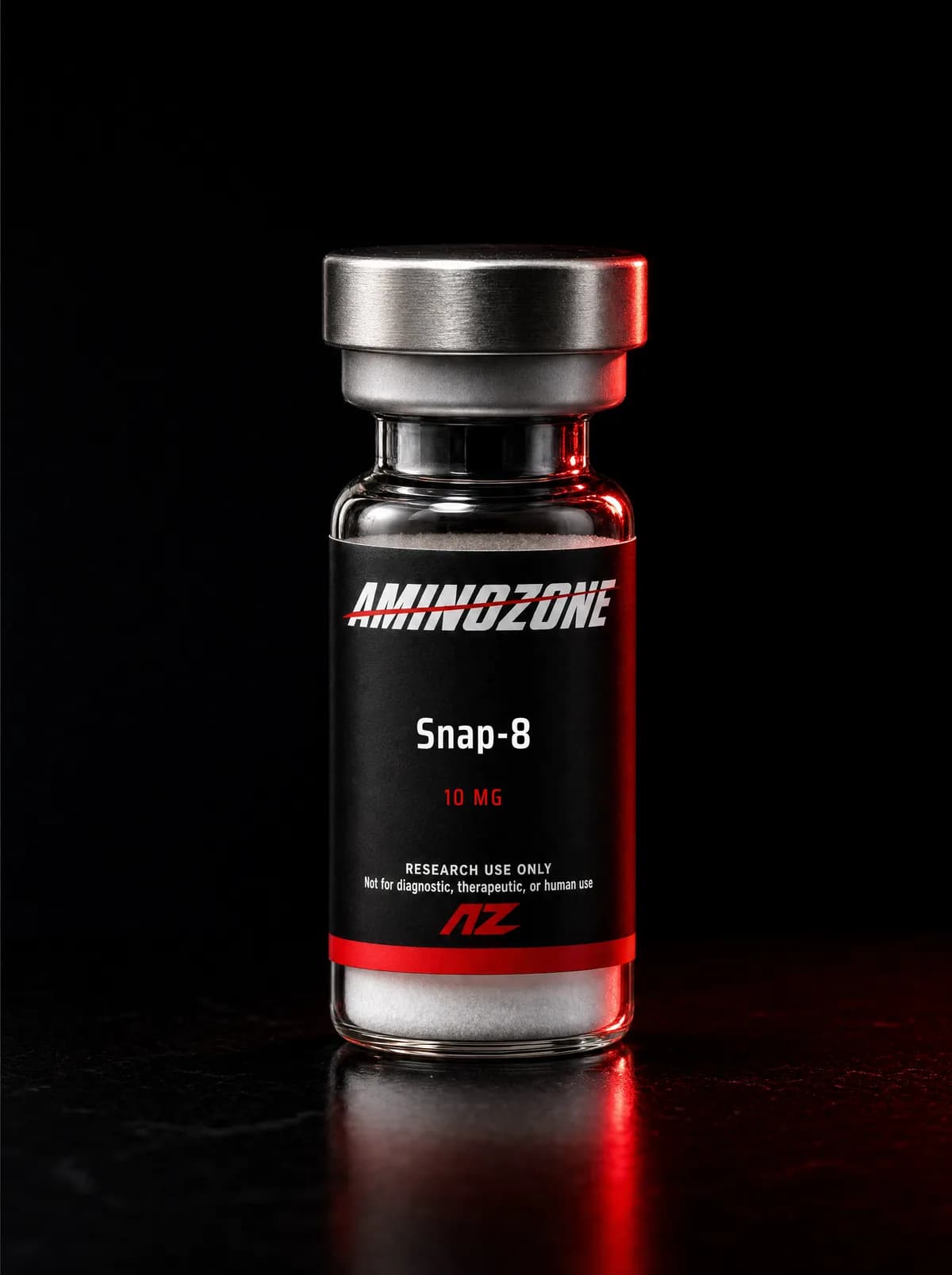
Snap-8 is a synthetic octapeptide studied in research for its effects on SNARE (Soluble NSF Attachment Protein Receptor) complex assembly and the regulated exocytosis of neurotransmitters. It is catalogued under CAS number 868844-74-0 with a molecular formula of C₄₁H₇₀N₁₆O₁₆ and a molecular weight of 1075.09 g/mol. The compound is supplied as a lyophilized powder for laboratory research and is intended solely for research purposes, not for human use.
Within neuroscience and cell biology research, Snap-8 is studied as a peptide that mimics the N-terminal region of SNAP-25, a core component of the SNARE complex responsible for synaptic vesicle fusion with the plasma membrane. Its research interest centers on the ability to modulate SNARE complex formation by competing with native SNAP-25 for integration into the complex—making it a useful molecular tool for investigating SNARE-dependent exocytotic mechanisms in model systems.
Research applications span neurotransmitter release kinetics, SNARE protein assembly dynamics, vesicle fusion studies, and investigation of regulated secretory pathway mechanics in neuronal and non-neuronal cell types. It is catalogued and studied as a distinct compound from the shorter hexapeptide analogs in the same mechanistic class because its 8-residue chain length confers a distinct SNARE interaction profile.
What is the molecular structure of Snap-8?
Snap-8 has a molecular weight of 1075.09 g/mol and the molecular formula C₄₁H₇₀N₁₆O₁₆. It is an 8-amino acid synthetic peptide with an N-terminal acetyl group, based on the N-terminal sequence of the endogenous SNARE protein SNAP-25. The acetylation at the N-terminus is a deliberate structural feature: it protects the peptide from exopeptidase degradation at that terminus and is characteristic of the class of SNAP-25-mimicking research peptides.
The peptide sequence corresponds to the N-terminal domain of SNAP-25 that participates in SNARE four-helix bundle assembly. This structural correspondence is the basis for its proposed mechanism of action in research models: by presenting the same N-terminal sequence as native SNAP-25, Snap-8 can compete with the endogenous protein for the intermolecular contacts that drive SNARE complex formation.
The research-grade material is characterized to a purity specification of 99%+ by HPLC—among the highest purity specifications in the research peptide catalog—with mass spectrometry identity confirmation. It is supplied as a lyophilized white to off-white powder stored at −20°C. The high purity specification is relevant for cell-based SNARE research assays where peptide impurities can complicate protein interaction data.
What is the SNARE complex and why is it a research target?
The SNARE complex is a conserved molecular machine responsible for driving the fusion of intracellular vesicles with target membranes in eukaryotic cells. It is essential for regulated secretory processes including synaptic neurotransmitter release, endocrine hormone secretion, and a wide range of vesicle-mediated trafficking events throughout cell biology.
The minimal neuronal SNARE complex is formed by three proteins: syntaxin-1 (a t-SNARE anchored in the plasma membrane), SNAP-25 (a t-SNARE associated with the plasma membrane via palmitoylation), and synaptobrevin-2/VAMP-2 (a v-SNARE anchored in the synaptic vesicle membrane). These three proteins contribute helical domains that zip together in a parallel coiled-coil arrangement, forming a thermodynamically stable four-helix bundle—SNAP-25 contributes two helices, while syntaxin-1 and synaptobrevin each contribute one.
The energy released by this zipper-like coiled-coil assembly is coupled to membrane fusion, driving the merger of the vesicle and plasma membranes and enabling exocytosis of vesicle contents. Research into this mechanism is relevant across neuroscience, cell biology, and pharmacology: SNARE complex formation is a rate-limiting step in neurotransmitter release, and SNARE disruption has documented effects on the kinetics and amplitude of exocytotic events in model systems. Snap-8 is used as a research tool to probe this mechanism by interfering with the SNAP-25 contribution to complex assembly.
What is SNAP-25 and how does Snap-8 structurally relate to it?
SNAP-25 (Synaptosomal-Associated Protein 25 kDa) is one of the three canonical neuronal SNARE proteins and contributes two of the four helices in the SNARE four-helix bundle complex. It is a peripheral membrane protein associated with the cytoplasmic face of the plasma membrane through palmitoylated cysteine residues in its central linker region.
The protein has two helical domains—referred to as the N-terminal SNARE motif and the C-terminal SNARE motif—both of which participate in SNARE complex assembly. The N-terminal SNARE motif is the region that Snap-8 is designed to mimic. By presenting an 8-residue sequence corresponding to this N-terminal domain, Snap-8 is studied as a competitive modulator of the protein-protein interaction at that site in the complex.
In research models examining SNARE complex kinetics, this structural correspondence allows Snap-8 to be used as a probe for the mechanistic importance of the N-terminal SNAP-25 contribution to complex assembly rate and stability. The distinction from the endogenous protein matters for experimental design: Snap-8 does not replicate the full SNARE interaction surface of SNAP-25, which makes it a selective modulator of one aspect of complex formation rather than a complete SNAP-25 replacement.
Property
SNAP-25 (endogenous)
Snap-8
Type
Full 25 kDa t-SNARE protein
Synthetic 8-amino acid N-terminal mimic
Chain length
~206 amino acids
8 amino acids
Molecular weight
~25,000 g/mol
1075.09 g/mol
SNARE role
Forms two helices of the four-helix bundle
Studied as competitive modulator at N-terminal domain
Research application
Endogenous complex component reference
Probe for N-terminal SNAP-25 interaction in SNARE assembly
Structural feature
Palmitoylated membrane anchor
Acetylated N-terminus for stability
How does Snap-8 interact with SNARE complex assembly in research models?
The proposed mechanism of Snap-8 in research models is competitive inhibition of SNARE complex formation via displacement of native SNAP-25 from the N-terminal interaction site on the assembling complex. By occupying the binding contacts contributed by the N-terminal SNARE motif of SNAP-25, Snap-8 reduces the efficiency of full SNARE four-helix bundle assembly, which in turn is studied for its effects on vesicle fusion kinetics in model systems.
In vitro assays examining this mechanism use cell-free SNARE reconstitution systems, fluorescence-based fusion assays with proteoliposome models, and co-immunoprecipitation approaches to document the effect of Snap-8 on complex formation in a controlled environment. These assay formats allow researchers to characterize concentration-response relationships between Snap-8 and SNARE complex yield, independent of the cellular context that introduces additional regulatory variables.
Cell-based studies complement the in vitro data by examining how Snap-8 affects regulated exocytosis in neuronal and neuroendocrine cell models where SNARE-dependent vesicle fusion can be monitored by amperometry, total internal reflection fluorescence microscopy, or neurotransmitter release measurements. The compound is used at concentrations calibrated to the SNARE interaction literature, and AminoZone makes no therapeutic or outcome claims regarding Snap-8; it is studied solely for its effects on SNARE protein complex dynamics in research settings.
How does Snap-8 compare to shorter SNARE-targeting peptides in research models?
Snap-8 is an 8-amino acid peptide. Structurally related SNAP-25-targeting peptides include shorter analogs of 5–7 residues, the most studied being the 6-residue acetyl hexapeptide. The difference in chain length has documented consequences for SNARE interaction properties in the published literature.
Longer peptides in this class generally present more of the native N-terminal SNAP-25 interaction surface, which affects the precision of the competitive interaction at the SNARE complex interface. The 8-residue chain of Snap-8 covers more of this interface than 5- or 6-residue analogs, which is the primary reason it is studied separately in mechanistic research designs that require more complete occupancy of the N-terminal site.
For researchers designing SNARE interaction studies, the choice between chain-length variants depends on the specific mechanistic question being asked. Short analogs may be sufficient for competition assays where partial occupancy is acceptable. Longer analogs like Snap-8 are selected when research requires engagement of a broader portion of the SNAP-25 N-terminal interaction surface. This distinction is meaningful for interpreting concentration-response data and for designing experiments where SNARE complex stoichiometry is a controlled variable.
What handling and storage requirements apply to Snap-8?
Snap-8 is supplied as a lyophilized powder and is stored at −20°C to preserve structural integrity. As an octapeptide, it is generally more proteolytically stable than larger proteins but remains sensitive to hydrolysis, oxidation, and moisture during handling. The N-terminal acetyl group provides stability at that terminus; however, the internal peptide bonds are still subject to degradation under suboptimal storage conditions.
Research handling practices that support reproducibility include maintaining consistent cold storage, minimizing freeze-thaw cycles, and protecting the lyophilized material from moisture exposure during weighing and handling.
This article does not provide reconstitution or preparation instructions. All handling and preparation protocols are determined by the researcher according to their experimental requirements and applicable regulations.
How does AminoZone supply Snap-8?
AminoZone supplies Snap-8 as a research-grade compound at a purity specification of 99%+ by HPLC, with mass spectrometry identity confirmation. Every batch has a batch-specific Certificate of Analysis on file documenting those results. The 99%+ specification is at the upper end of the research peptide purity range, which is directly relevant for SNARE protein interaction assays where peptide impurities can introduce competing signals in protein-binding readouts.
For a breakdown of what HPLC purity and mass spectrometry confirmation actually measure—and why those numbers matter for research reproducibility—see our overview of research peptide purity standards. Specifications, available sizes, and pricing for Snap-8 are on the Snap-8 product page. The full AminoZone research compound catalog, including related peptides studied in secretory pathway and protein interaction research, is available at all compounds. All material is intended for laboratory research use only. Not for human use.
This compound is a research chemical intended for laboratory and scientific research purposes only. It is not a drug, supplement, or food product, and is not intended to diagnose, treat, cure, or prevent any disease. AminoZone does not sell products for human consumption. Researchers are responsible for compliance with all applicable local, state, and federal regulations governing the purchase and use of research materials.